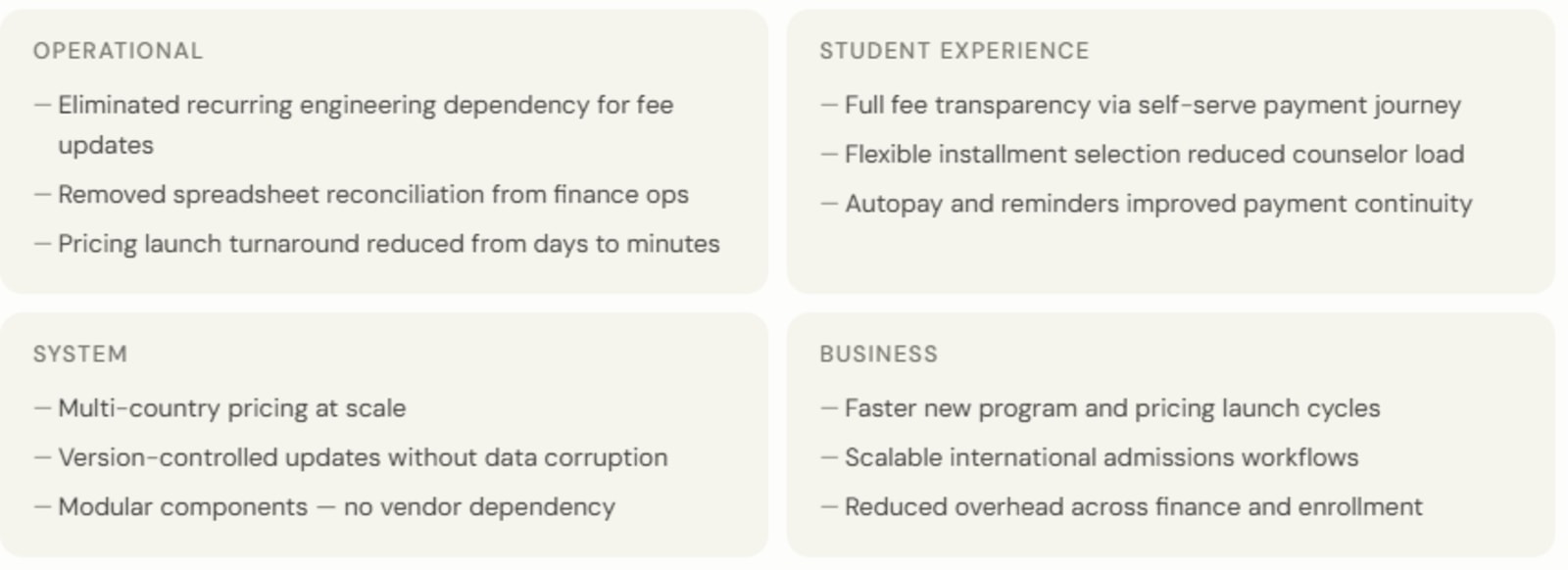
Increased student submissions by 18%
Improved the AMS payment journey for USDC Global, reducing friction and boosting Application completion rates
What I Achieved
My Work
Product Ownership, UX Audit, User Research, Problem Framing, Product Strategy, Responsive Design
Team


- Karthik Panchala (me), Product designer I
- Rajesh Mahale, Product Manager
Time Line
3 to 4 months
The problem wasn't one thing. It was three.
01: Student side Students were dropping off before they ever paid. The enrollment journey was broken at every critical step.
02: Admin side Admins had no real tool. Fee structures lived in Excel, pricing was hardcoded, and every update needed an engineering ticket.
03: System level Universities couldn't manage billing complexity at scale. Every fee exception became operational debt.
The fix wasn't three separate solutions. It was one connected system.
Case study 01 · Student experience
The enrollment journey was broken before students paid a rupee.
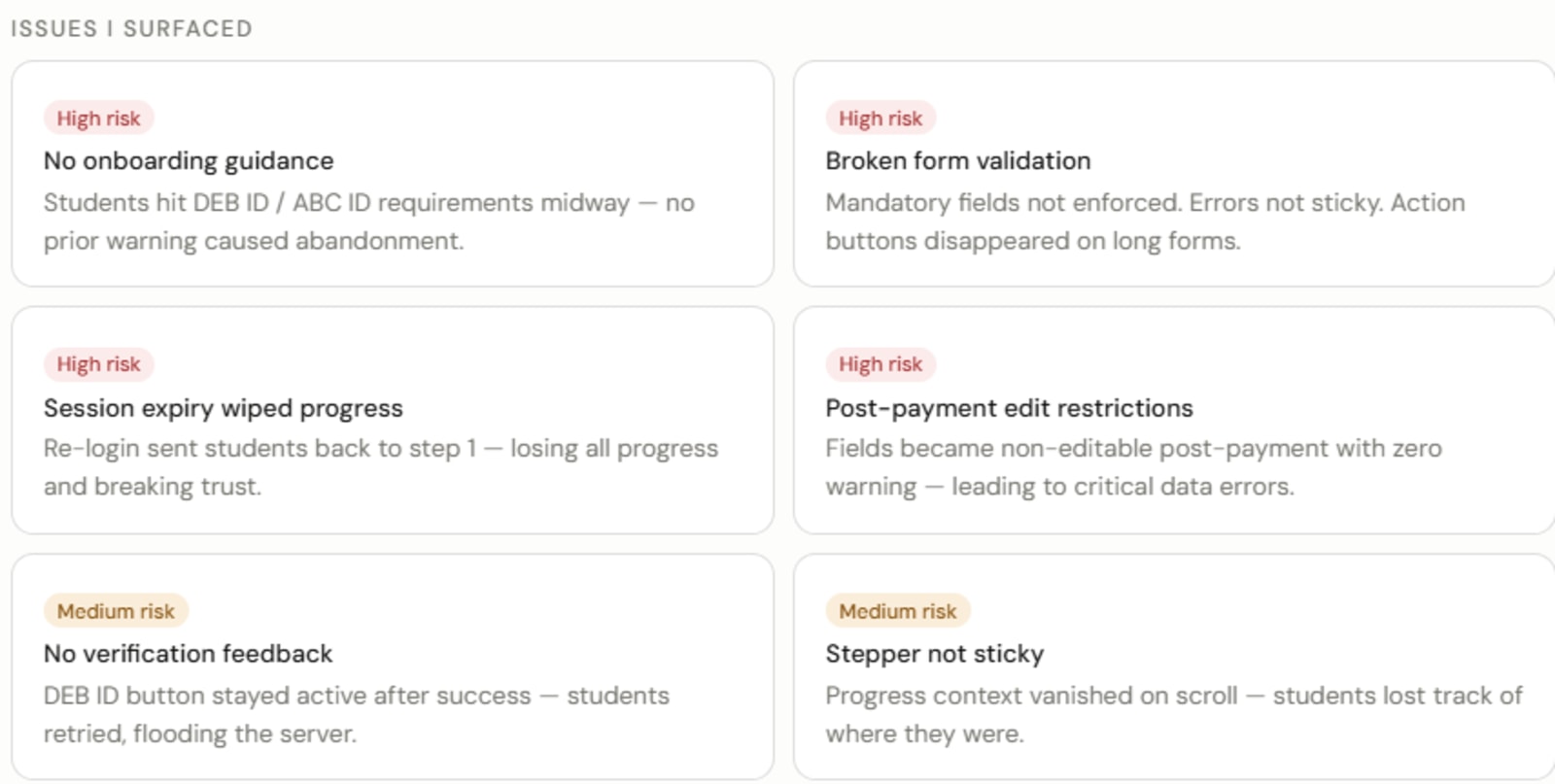
In the AMS flow, I conducted a comprehensive heuristic audit of the onboarding and application journey, identifying 7 critical usability issues. Of these, 5 were high-impact problems directly contributing to user drop-offs and unsuccessful application submissions.
Heuristic Report
How I Reframed It
UI bug list → Enrollment drop-off problem
Fix broken screens → Redesign the journey for confidence
Payment step only → Self-serve: application to fee clearance
What I designed
A "Before You Start" checklist to surface document requirements before form entry. Sticky form validation with real-time errors. Persistent stepper navigation. State-preserved session recovery. A self-serve payment experience with transparent fee breakdowns and installment selection. The payment layer is detailed in Case Study 03.
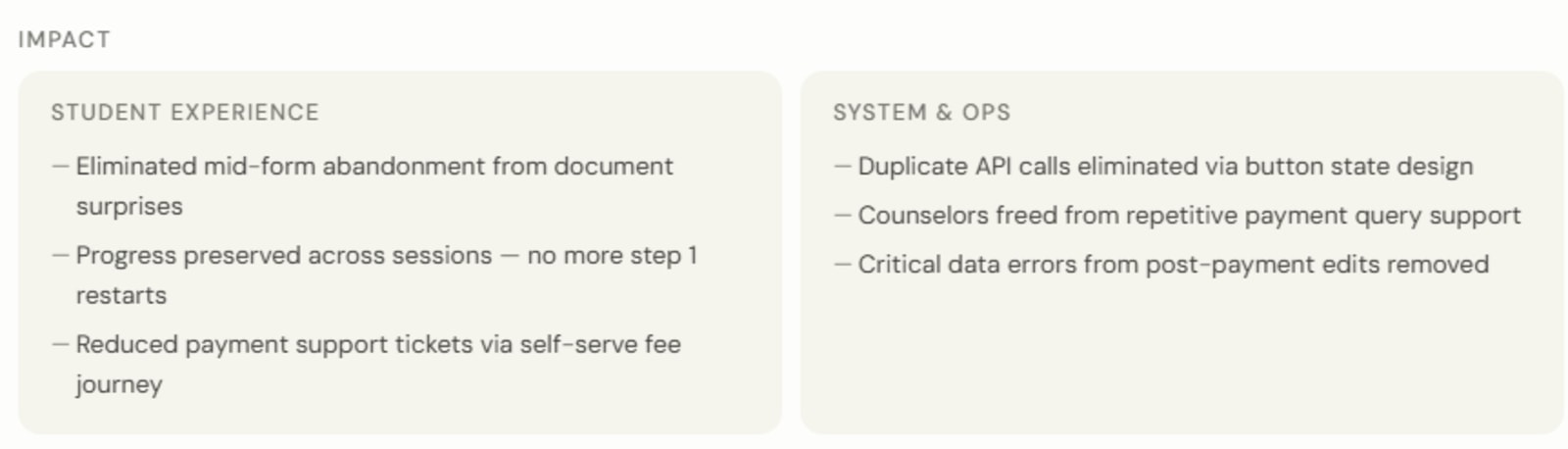
Final Design
I have included only one frame due to company restrictions. The Figma file is password-protected. Please feel free to reach out to me for any further discussion.
Figma Design
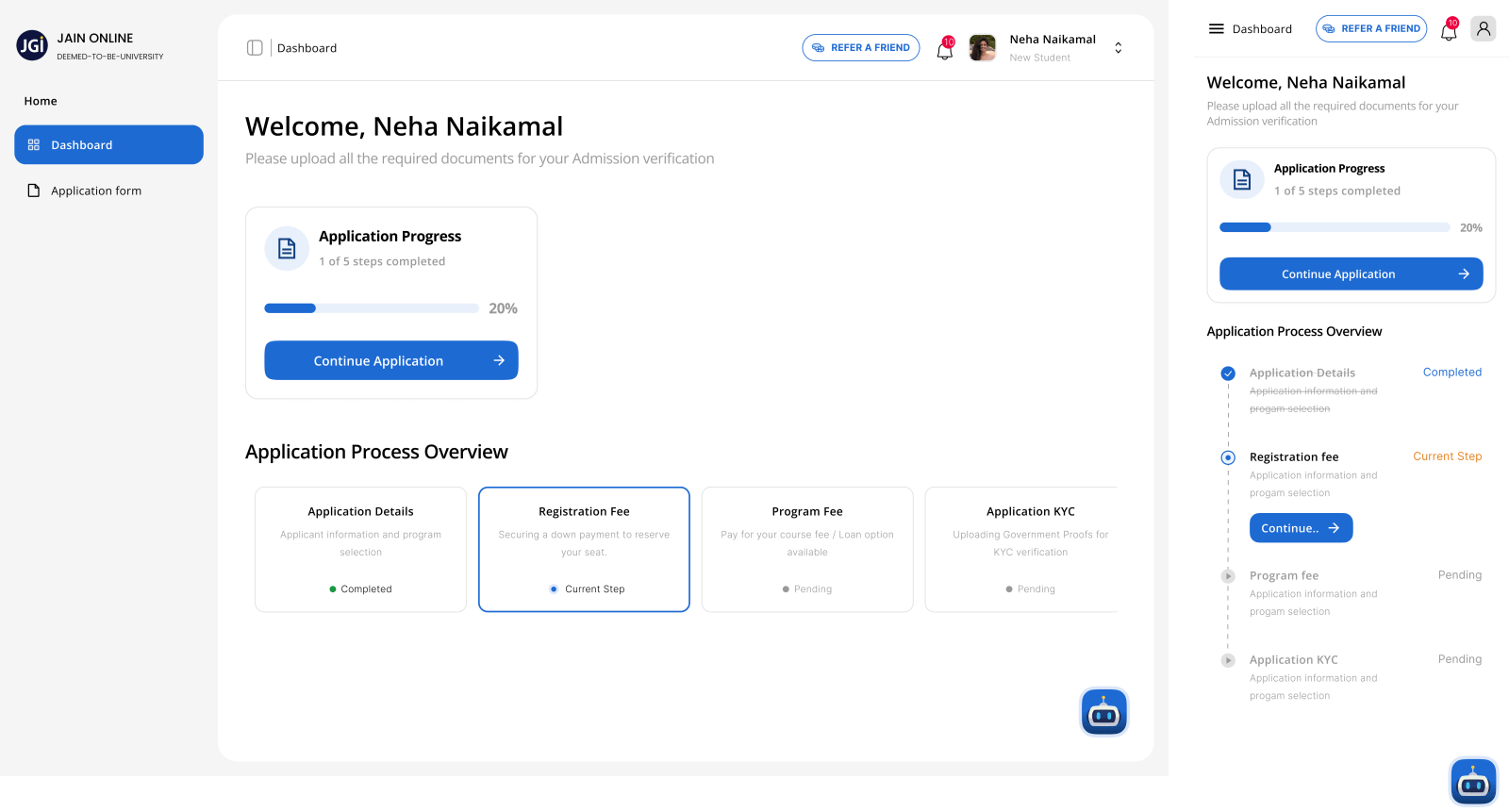
The biggest insight: enrollment teams had quietly become student support teams. Every drop-off was a lost conversion and every support ticket was a counselor pulled away from actual enrollment work.
While solving the student-side flows, I traced payment confusion back upstream: fee structures were running on Excel, with pricing hardcoded in the system. That discovery led directly to Case Study 02.
Case study 02 · Admin experience
Fee management was running on Excel and prayer.
Replacing a spreadsheet-driven, engineering-dependent fee setup with a configurable admin system that universities operate independently no tickets, no dev dependency.
How I found the problem
The student-side audit revealed an upstream root cause fee data itself was broken at the source.
Working through the student journey, I traced billing inconsistencies back to the admin layer: fee structures maintained in Excel, pricing hardcoded into the system. Any update semester pricing, installment plans, country-level fees required engineering intervention and finance approvals. I identified this as a higher-priority issue and solved both layers simultaneously.
Solution Explored

I chose flexibility over simplicity accepting a steeper admin onboarding curve in exchange for eliminating recurring operational dependency.
Scope I defined
Multi-country pricing
Semester-wise fee config
Installment orchestration
Effective-date versioning
Discount & autopay rules
Fee component modularization
How I Reframed It
Fee collection module → Revenue operating system
Engineering-gated updates → Admin-owned configuration
Spreadsheet workaround → Configurable billing infrastructure
Final Design
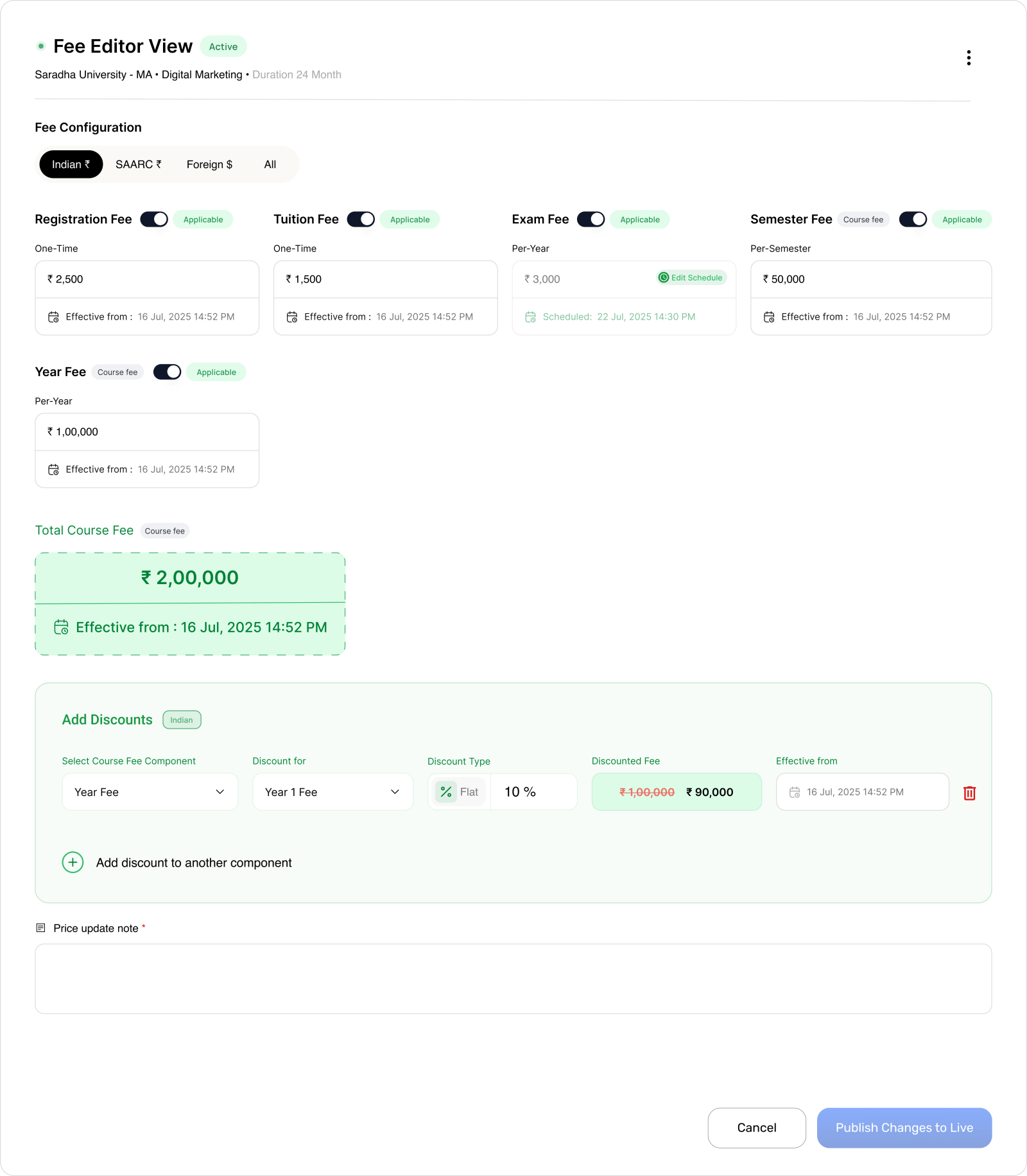
I have included only one frame due to company restrictions. The Figma file is password-protected. Please feel free to reach out to me for any further discussion.
Figma Design
Impact
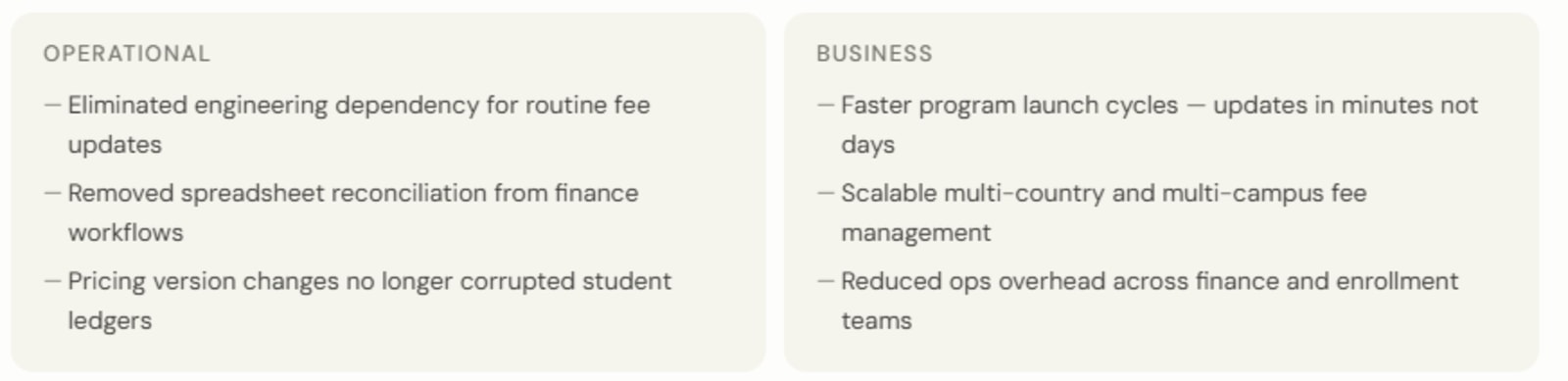
Solving the student experience without fixing the admin layer would have patched the surface without touching the system. Both had to move together.
With both the student journey and admin configuration redesigned, fee management became the single biggest business lever in the system affecting enrollment conversion, revenue speed, and operational overhead simultaneously. Case Study 03 tells that story in full.
Case study 03 · System-level thinking
Universities don't have a payment problem. They have a fee logic problem.
Redesigning university fee infrastructure from scratch from fragmented spreadsheet-driven operations to a configurable billing engine that admins own end to end.
The problem I identified
The problem wasn't payment collection. It was fee orchestration.
Universities managing multiple campuses, online programs, and international admissions were still running fee operations through spreadsheets, rigid ERPs, and manual reconciliation. A routine change updating semester pricing, enabling installments, launching country-specific fees often required engineering intervention that took days instead of minutes. I identified three recurring failure patterns across the industry before defining the solution.
Patterns I found in research

Key decision: effective-date versioning
One architectural insight changed everything. Universities needed to update pricing without corrupting existing student invoices. I designed effective-date fee versioning existing students retain old pricing automatically; new admissions inherit updated structures. This removed the single largest operational risk in university billing.
How I Reframed It
Fee management module → Revenue operating system
Static course pricing → Modular billing components
Finance admin tool → Enrollment enable
Final Design
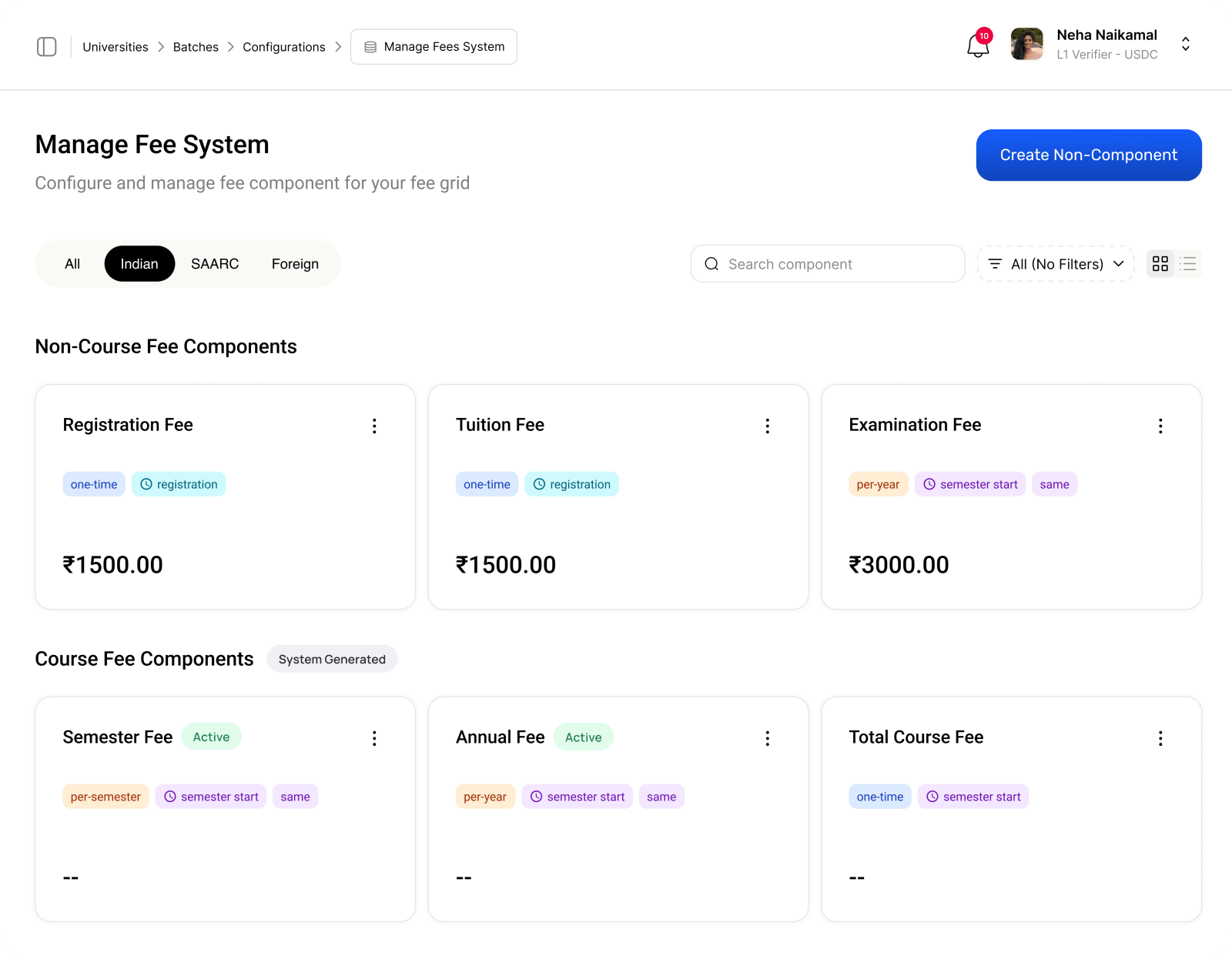
I have included only one frame due to company restrictions. The Figma file is password-protected. Please feel free to reach out to me for any further discussion.
Figma Design
Impact